
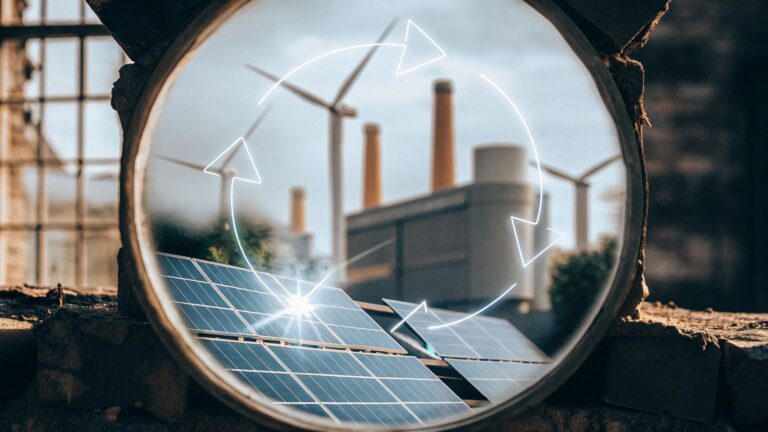
In 2025, the concept of circular energy gained central importance in the global industrial transition.
What started as an ecological principle has evolved into an economic model that reduces waste, lowers operating costs, and strengthens the resilience of energy infrastructures.
Today, energy companies are adopting technologies and processes that recover heat, materials, and components — creating continuous and regenerative cycles across their operations.
The value of circular economy in the energy sector
According to the Circularity Gap Report 2025 by Circle Economy, only 6.9% of the global economy is truly circular. Yet, the potential within the energy sector remains vast.
Recycling materials from turbines, solar panels, and lithium batteries can cut emissions by up to 35%.
Companies that apply Circular O&M models save up to 20% in maintenance and logistics costs by reusing components and optimizing their supply chains.
Circular Engineering: designing for reuse
The transition starts at the design phase.
Modern plants are now built to be modular, dismountable, and recyclable.
In Europe, over 40% of new EPC projects launched in 2025 include “design for reuse” components, supported by the European Commission’s Green Deal Industrial Plan.
Through its Engineering and Procurement divisions, Taiyo Holding integrates sustainable sourcing and circular engineering practices to ensure low-impact project execution.
Energy recovery and industrial waste management
Beyond materials, energy itself is becoming circular.
Waste heat recovery, local microgrids, and water reuse in industrial cycles help reduce total energy consumption by up to 30%.
Examples from European cogeneration plants and industrial symbiosis networks show how one company’s by-product can serve as another’s resource, achieving near-zero waste.
Digitalization and resource traceability
Circular energy depends on data.
By 2026, IoT and blockchain-based systems are enabling full lifecycle monitoring of industrial materials, ensuring transparency and traceability.
Taiyo Holding applies predictive analytics and digital twin solutions to optimize maintenance processes, resource reuse, and operational efficiency.
Toward a regenerative future
Circular energy is not just a technical shift — it’s a cultural transformation.
It marks the transition from a linear model to one of continuous regeneration, where every resource has more than one life.
In 2026, the companies adopting circular strategies will be those combining sustainability, competitiveness, and innovation — leading the next generation of global energy excellence.
Source:
- International Energy Agency (IEA) – Circular Economy Policy Database
- U.S. Department of Energy (DOE) – Circularity for Secure and Sustainable Products & Materials Report 2024