Quality Is a Project Performance Driver
In complex energy and industrial projects, quality is not simply a final inspection activity. It is a process that begins long before equipment reaches the construction site.
Modern projects rely on increasingly interconnected global supply chains involving engineering companies, manufacturers, subcontractors, specialized vendors and field teams operating across multiple countries.
Every interface introduces potential risks: non-conforming materials, documentation gaps, manufacturing delays, specification deviations or late deliveries can affect construction schedules, commissioning and ultimately the operational reliability of an asset.
This is why Quality Assurance (QA), Quality Control (QC), Inspection and Expediting have become critical components of effective project execution.
The objective is no longer simply to identify defects.
It is to prevent problems before they affect project performance.
ISO describes quality assurance as a systematic process designed to ensure that products, services and processes consistently meet defined requirements. It emphasizes prevention, risk identification, monitoring and continual improvement rather than relying only on corrective action after a problem occurs.
From Quality Control to Technical Assurance
Quality Assurance and Quality Control are closely related, but they address different dimensions of project quality.
Quality Assurance focuses primarily on processes. It establishes the procedures, responsibilities, documentation and management systems required to prevent non-conformities.
Quality Control, on the other hand, verifies whether specific materials, components or activities meet the required technical specifications and acceptance criteria.
Inspection provides another layer of verification by checking products and equipment at defined stages of manufacturing, construction or delivery.
Together, these activities create a broader framework of technical assurance.
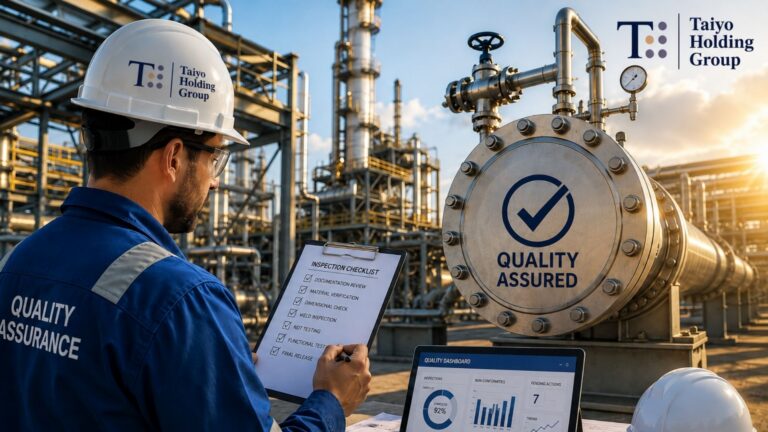
Typical activities can include:
- Review of technical documentation and quality plans
- Vendor qualification and surveillance
- Inspection and Test Plan (ITP) verification
- Material and equipment inspection
- Welding and fabrication control
- Non-Destructive Testing (NDT)
- Factory Acceptance Tests (FAT)
- Verification of certificates and manufacturing records
- Non-conformity management
- Final release and documentation review
When these controls are integrated throughout the project lifecycle, quality becomes a preventive management tool rather than a final checkpoint.
Why Inspection Matters Across the Project Lifecycle
Inspection is most effective when it begins early.
Waiting until equipment arrives on site to identify a manufacturing or documentation problem can create significant consequences for construction and commissioning.
A more effective approach establishes verification points throughout the supply chain.
1. Engineering and Procurement
Technical specifications, applicable codes, inspection requirements and acceptance criteria need to be clearly established before purchasing.
Quality planning at this stage reduces ambiguity later in the project.
2. Manufacturing
Vendor inspections allow project teams to verify that equipment and components are manufactured according to approved drawings, procedures and specifications.
This is particularly important for critical equipment where deviations may affect safety, reliability or future maintenance.
3. Testing and Release
Testing activities such as FAT provide evidence that equipment meets defined performance and functional requirements before shipment.
Documentation review is equally important: an equipment package is not truly complete if its technical records are incomplete.
4. Construction and Commissioning
Site inspection verifies installation quality and conformity before systems are energized, tested or commissioned.
The result is greater continuity between engineering intent, manufactured equipment and final installation.
Expediting: Protecting the Project Schedule
Quality alone is not sufficient.
Equipment also needs to arrive when the project needs it.
This is where expediting becomes strategically important.
Expediting monitors vendor progress against procurement and project schedules, identifying potential delays before they become critical.
Activities may include:
- Monitoring manufacturing milestones
- Reviewing vendor production schedules
- Tracking critical documentation
- Identifying procurement bottlenecks
- Following material availability
- Coordinating inspection activities
- Monitoring shipment readiness
- Reporting deviations and recovery actions
In major EPC projects, a delayed critical component can influence multiple downstream activities.
The relationship between Inspection and Expediting is therefore particularly important.
Inspection answers:
“Does the equipment meet the required specifications?”
Expediting answers:
“Will the equipment be ready when the project requires it?”
Together, they protect two fundamental project objectives: quality and schedule.
Quality Management as Risk Management
One of the most important evolutions in modern quality management is the shift from reactive control toward risk-based thinking.
ISO 9001 establishes a quality-management framework based on elements including process management, monitoring, performance evaluation, continual improvement and risk-based thinking. ISO also highlights that effective QA should identify where risks matter most and prioritize quality activities accordingly.
For energy and industrial projects, this means inspection resources should not necessarily be distributed equally across every component.
A risk-based approach can consider:
Technical criticality — What happens if the component fails?
Schedule criticality — Could a delay affect the project’s critical path?
Vendor performance — Is the supplier proven or does it require additional surveillance?
Manufacturing complexity — Does fabrication involve specialized processes or demanding tolerances?
Safety impact — Could non-conformity create risks during installation or operation?
This allows project teams to focus resources where technical and commercial exposure is greatest.
The Global Supply Chain Challenge
Energy infrastructure increasingly depends on equipment manufactured through international supply chains.
A single project may involve engineering in one country, equipment manufactured in another, specialist components sourced from several markets and final installation somewhere else entirely.
This creates a fundamental challenge:
How can a project maintain consistent quality across geographically distributed suppliers?
Effective vendor surveillance provides part of the answer.
Local inspectors and technical specialists can verify manufacturing activities directly at vendor facilities, while centralized project teams maintain common procedures, reporting standards and acceptance criteria.
This combination of local presence and centralized technical governance can help reduce communication gaps and provide greater visibility across the supply chain.
Taiyo Holding: Inspection, Quality and Expediting Across Global Projects
For Taiyo Holding, quality and inspection form part of a broader multidisciplinary approach to project execution.
The Group’s services include Expediting, Inspection & Quality, alongside Engineering, Project & Field Management, EPC, Commissioning, O&M and technical support.
This integration enables quality activities to be connected with the wider needs of the project rather than treated as isolated controls.
Taiyo’s international presence in Italy, the United Kingdom, Germany and Egypt, including the T-MENA unit in Cairo, supports coordination across international projects and supply chains.
Its management system includes certifications to ISO 9001, ISO 14001 and ISO 45001, reinforcing an integrated approach to quality, environmental management and occupational health and safety.
Taiyo also provides technical training capabilities in areas including NDT, welder qualification and production quality assurance, supporting the development of specialized competencies required in industrial environments.
The objective is straightforward:
identify risks early, verify compliance and support reliable project execution from vendor manufacturing to field operations.
The Human Factor Behind Technical Quality
Technology and procedures are essential, but inspection remains highly dependent on technical competence.
Inspectors must be capable of understanding engineering documentation, manufacturing processes, applicable standards and acceptance criteria while communicating effectively with vendors and project teams.
Different equipment categories also require different expertise.
Mechanical equipment, electrical systems, instrumentation, piping, pressure equipment, structural fabrication and welding cannot necessarily be evaluated using the same technical profile.
For this reason, competence management and specialized training remain fundamental parts of an effective quality strategy.
Technical assurance ultimately depends not only on having the right procedure, but also on having the right professional applying it at the right stage of the project.
Digital Inspection: The Next Evolution of Quality Assurance
Digital transformation is also changing how inspection and quality information can be managed.
The future of technical assurance will increasingly combine specialist field expertise with digital tools.
Potential applications include:
- Digital inspection reports
- Remote technical collaboration
- Real-time quality dashboards
- Automated document workflows
- Digital traceability of equipment and materials
- Data analytics for non-conformity trends
- AI-assisted analysis of quality information
- Integration between inspection data and digital asset records
The objective is not to replace inspectors.
It is to provide project teams with better information, faster visibility and stronger traceability.
Digital records can also create value beyond construction.
Inspection and commissioning information generated during project execution can become part of the asset’s technical history, supporting future maintenance, troubleshooting and lifecycle management.
Quality 2026 and Beyond: From Compliance to Performance
Quality management itself continues to evolve.
ISO is currently finalizing the next edition of ISO 9001, with publication scheduled for September 2026. The forthcoming revision places increased emphasis on areas including leadership, quality culture, accountability and the management of risks and opportunities.
This reflects a broader shift in industrial quality.
The future will increasingly move beyond asking:
“Is this component compliant?”
toward asking:
“How does quality contribute to project performance, reliability and long-term value?”
For energy projects, this means closer integration between engineering, procurement, inspection, construction, commissioning and operations.
Quality becomes not simply a contractual requirement, but an integral part of project risk management and operational excellence.
Conclusion
Complex energy projects depend on thousands of technical decisions, components, documents and interfaces.
A single non-conformity discovered too late can influence procurement, construction, commissioning and operations.
Effective technical assurance therefore begins much earlier.
Through Quality Assurance, Quality Control, Inspection and Expediting, project teams can identify risks, monitor vendors, verify technical compliance and protect critical project milestones.
For Taiyo Holding, these capabilities are part of an integrated multidisciplinary model connecting engineering expertise with field execution and lifecycle support.
Because successful projects are not built by inspecting quality at the end.
They are built by integrating quality into every stage.